

Plane Wave |  |
The plane wave source algorithm generates a plane wave within a specified closed rectilinear volume. A plane wave is useful when computing the electromagnetic responses from a source that exists at a great distance from the object being modeled. The plane wave is generated by computing electric and magnetic current density values on the equivalent surface of the rectilinear volume. These are then injected into the equivalent surface electric and magnetic fields in the proper manner, and with the proper retardation time, to generate a plane wave within the surface boundary. The plane wave is confined to the equivalent surface volume.
 Instructions
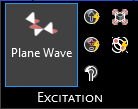
Click
 Plane Wave within the Excitations section under either the EMA3D or MHARNESS tab in the ribbon.
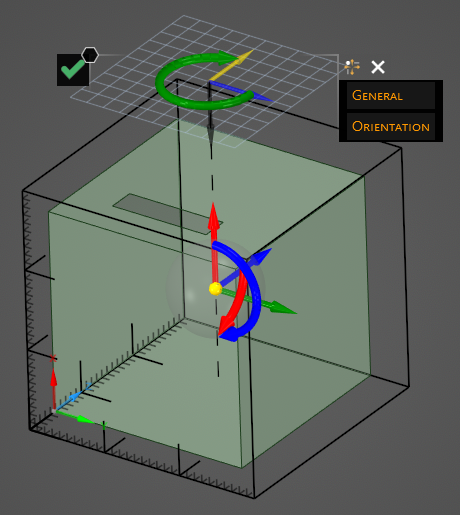
A set of arrows will appear in the model window. The straight, yellow arrow is the resultant electric field polarization vector, the straight, black arrow is the plane wave propagation vector, and the straight, blue arrow is the magnetic field vector. To see the vector labels, change Show Names to True in the Properties Panel.
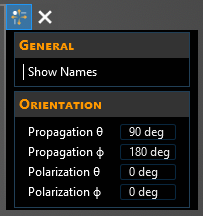
Adjust the properties of the plane wave propagation and polarization by dragging the curved red, blue, and green arrows. Alternatively, enter the propagation and polarization angles in the Properties panel.
Click OK
 to complete the plane wave source definition.
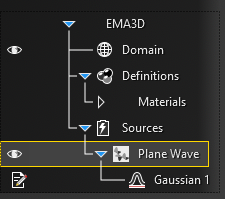
A Gaussian signal is automatically applied to the plane wave, but it can be edited or deleted and replaced by a different signal.
Adjust the definitions of the Plane Wave Source at any time by right clicking it within the Simulation Tree and selecting Edit from the pop-up menu.
 General
Entry | Meaning |
|---|---|
Show Names | Show names above plane wave orientation vectors. |
OrientationEntry | Meaning |
|---|---|
Propagation θ | Propagation vector polar angle (from Z axis). |
Propagation ϕ | Propagation vector azimuth angle (from X axis). |
Polarization θ | Polarization/Electric field vector polar angle (from Z axis). |
Polarization ϕ | Polarization/Electric field vector azimuth angle (from X axis). |
See AlsoOther Resources
EMA3D – © 2026 EMA, Inc. Unauthorized use, distribution, or duplication is prohibited.